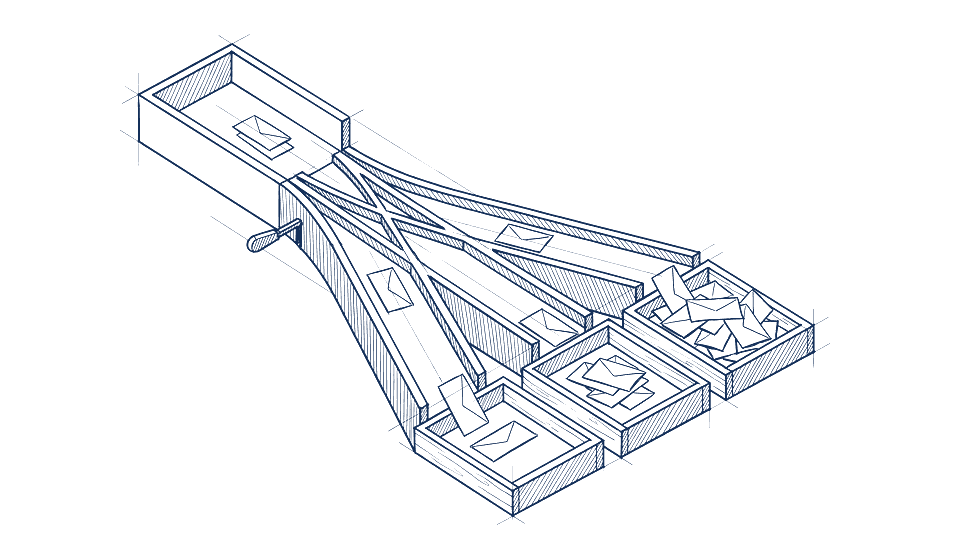
What lead qualification with AI actually does
We do not mean a points system that counts website visits. We mean a workflow that handles every incoming enquiry the way an experienced sales office would, only immediately and around the clock. It carries out five steps:
- Read: form, email, chat history or telephone note, including attachments, in any language.
- Classify: sales opportunity, existing customer with a question, complaint, job application, supplier, press or spam.
- Extract characteristics: company, country, industry, product or product group, quantity, date, contact.
- Distribute: according to fixed rules to the responsible team, as a complete record in the CRM.
- Prepare: a draft reply from your sources, which a person checks and sends.
On the surface little changes for sales: they keep working in their CRM, except that the enquiry is already there, created, assigned and with a draft, when they look in each morning. How we build this as a service is described under Sales and communication.
The model reads, the rules decide
The most important principle in the build: the language model understands the enquiry and fills in fields. Where it goes is decided by a rule that your sales team can read and change. Anyone who leaves the distribution itself to the model ("send this to the right person") gets decisions that cannot be justified and cannot be reliably repeated.
The separation has three advantages. Responsibilities stay where they are today: in a table, not in a prompt. A changed territory split is one line, not a project. And every distribution can be traced in the log: characteristic recognised, rule applied, team notified. If a sales manager asks why an enquiry ended up with Team North, there is an answer.
Catalogue of criteria for lead routing
The following table contains the criteria that decide responsibility in almost every B2B sales organisation. Go through them with your head of sales, cross out anything that does not apply to you and replace the example rule with your own. Whatever is unclear in the process would be unclear without AI too. It just comes to light now.
| Criterion | Where it comes from | Example rule | Typical borderline case |
|---|---|---|---|
| Type of enquiry | Text of the enquiry | Only sales opportunities go to sales, complaints go to service | An existing customer complains and at the same time asks about a new product |
| Country or region | Address, dialling code, email domain, text | Switzerland to Team South, Austria to the Vienna office | The company is based in country A, delivery goes to country B |
| Product group or market | Product name, item number, industry | Sensors to the specialist sensor sales team | The enquiry only describes an application, not a product |
| Existing or new customer | Comparison with the CRM | Existing customer to the responsible key account manager | A new person from a known company |
| Size of the opportunity | Stated quantity, project scope, company size | Above a set threshold, also to the head of sales | Quantity missing, a framework agreement is hinted at |
| Urgency | Stated date, breakdown, choice of words | A plant breakdown at the customer goes straight to the on-call service by phone | Urgency claimed, but no date given |
| Language | Detected language | Draft reply in the language of the enquiry | Enquiry in English from a German company |
| Completeness | Mandatory details present | An incomplete enquiry first gets a follow-up question, then distribution | A follow-up question to a major customer comes across as impolite |
Every row needs a fallback rule: what happens if the characteristic is missing or ambiguous? Our answer is always the same. The enquiry lands in a mailbox for people, visible and with the reason. Not in limbo, and not with a team picked by guesswork. The borderline cases in the fourth column are not exceptions but the part where the quality of a workflow shows. Set aside most of the time for them.
What the workflow should not do by itself
The closer an action is to the customer, the more approval it needs. A sensible gradation to start with:
- Classifying, extracting characteristics, creating in the CRM and distributing: automatic.
- Sorting out spam and obvious advertising: automatic, with a daily list for cross-checking.
- Acknowledgement with the name of the responsible contact: automatic, if you want it.
- A substantive reply with price, delivery time or a technical statement: draft, a person sends it.
- Rejection, decision on a complaint, discount: never automatic.
This line can be moved later if the figures justify it. The other way round is harder: a single wrong automatic reply that reaches a customer costs more trust than a hundred correct ones earn.
Two legal points belong in the planning. Anyone using a chat window or automatic replies must, under Article 50(1) of the EU AI Act, Regulation (EU) 2024/1689, ensure that people are informed that they are interacting with an AI system, unless this is obvious. And automatically assigning business enquiries is as a rule not an automated individual decision within the meaning of Article 22 GDPR, because it has no legal effect on the person making the enquiry and a person decides on the offer. Check your case with your data protection officer. This article is not legal advice.
Where the draft replies get their knowledge
A draft reply is only as good as the sources it is created from. A language model does not know your prices, delivery times and product variants, and it should not guess them either. That is why the workflow gets a fixed list of sources it may draw on: the current price list, data sheets, delivery times from the ERP, responsibilities from the CRM, approved standard paragraphs for recurring questions. Every draft states which source a statement comes from, so that the person checking does not have to search.
If a detail is missing from the sources, the draft says so instead of inventing a figure. A draft with the note "delivery time for variant B not on file" is more useful than one that sounds smooth and is wrong.
Two weeks in shadow mode before the workflow takes over
No head of sales should hand distribution over to a workflow they have not seen working. That is why it first runs in shadow mode: it assesses every enquiry, but sales works as before. Every day both results are compared. Where they differ, there is almost always a rule that nobody had written down, such as a particular major customer always going to the same colleague, no matter where the enquiry comes from. Only when the assessments agree over a set period does the workflow take over. Two weeks is usually enough; with large volumes or many markets it takes longer.
In this phase, do not only measure whether distribution was correct. These four figures belong in the weekly report:
- Time from receipt to the record reaching the responsible team.
- Share of enquiries distributed automatically, and share in the mailbox for people.
- Share of distributions that a team had to send back.
- Share of draft replies sent without changes.
The last figure is the most honest. If almost every draft is rewritten, the workflow is missing sources: a current price list, delivery times, data sheets. Then that is the next step, not a better prompt.
What this looks like at a technology distributor
A European technology distributor brings together eight specialist business units under one roof and sells through twelve European locations. Every enquiry is classified by market and country of origin and handed over to the responsible regional sales team, with a connection to NetSuite for the lead pipeline. A dashboard shows who is enquiring about what and where the enquiries come from, and sales plans its markets accordingly.
Since the relaunch, 400 percent more enquiries have come in from the website, and each one goes straight to the right team. The example shows why distribution and volume belong together: a sales team that had to forward many times the number of enquiries by hand would have no time left for selling. The details are in the case study on enquiries in five languages.
The prerequisite: a CRM you can trust
The "existing or new customer" check is fourth in the table, but it decides many of the other rows. If the workflow finds a company three times in the CRM, with three different people responsible, it cannot distribute correctly. If the country is missing for half of the companies, the regional rule has nothing to work with. Before routing starts, it is therefore worth looking at duplicates and empty fields in the data. How to go about this is described in the article Before AI is let into the CRM.
What this means for you
For one week, count how many enquiries come in, how many of them are genuine sales opportunities and how long it takes for the right person to see them. Take the catalogue of criteria to your next sales meeting and replace the example rules with yours. With these two documents, a single call is enough to clarify whether the workflow pays off for you and what it would look like.
Your next step: book a 30-minute call and bring the completed catalogue with you.
Further reading
- Before AI is let into the CRM: sorting out duplicates, mandatory fields and spellings
- AI at mid-sized companies: why ChatGPT has changed nothing in the business, and what works instead
- Service: sales and communication
- Case study: enquiries in five languages
- Industry: AI in distribution, with enquiries from many markets